
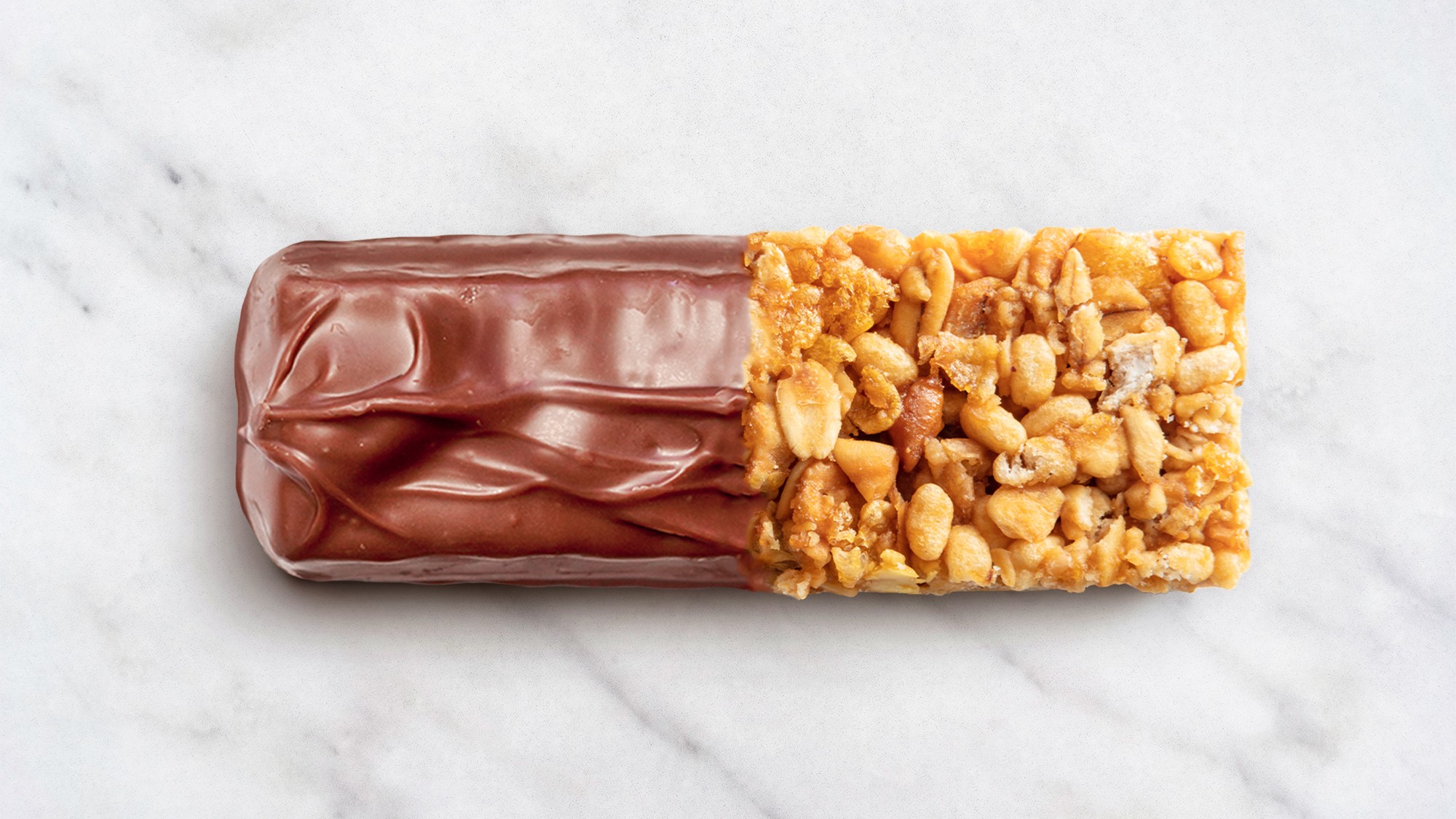
Eating candy for breakfast is not a good decision. But most mornings, I start my day with something that looks and tastes a lot like just that. The Built Puff protein bar is covered in chocolate and has a sweet coconut center, making it practically indistinguishable from a Mounds bar. Nutritionally, though, the two products are very different. A Mounds bar has north of 200 calories and 20 grams of added sugar. My bar has 140 calories, just six grams of added sugar, and about as much protein as three eggs.
Protein bars have come a long way from the chalky monstrosities that lined shelves not long ago. In this era of protein everything, they are successfully spoofing candy, but with much more impressive macronutrients. Built also makes bars in flavors such as Blue Razz Blast, Strawberries ‘n Cream, and Banana Cream Pie—all with a similar nutritional profile to my preferred coconut version. Another one of my favorites, the Barebells caramel-cashew bar, tastes like a mash-up of a Twix and a Snickers. There are rocky-road protein bars, birthday-cake protein bars coated in sprinkles, and snickerdoodle-flavored protein bars. In theory, I can eat frosted cinnamon rolls or a package of sour gummies without blowing my diet.
For anyone with a sweet tooth, it can feel like food companies have developed guilt-free candy. But that’s where things get disorienting. Some of these products are seemingly nutritionally benign, whereas others are nothing more than junk food trying to cash in on protein’s good reputation. The new protein-spiked Pop-Tarts contain the same amount of sugar as the original Pop-Tarts—30 grams. Or consider Gatorade’s protein bar, which has roughly as much sugar as a full-size Snickers. At this point, the line between protein bar and candy bar has never been blurrier.
[Read: America has entered late-stage protein]
If you’re confused, you’re not the only one. In 2023, a group of Gatorade customers sued PepsiCo, the brand’s parent company, over its sugary protein bars. They alleged that Gatorade was deceiving customers by labeling the products as protein bars as opposed to “a candy bar or dessert.” Pepsi’s lawyers said that it had not engaged in false advertising, because the sugar content was right there for anyone to see on the nutrition-facts label. (In October, the case against PepsiCo was resolved out of court; the bars are still loaded with sugar.)
The lawyers have a point: For some bars, the nutrition facts do tell a clear story. You don’t need to be a nutritionist to figure out that protein Pop-Tarts are not particularly good for you. Other cases, however, aren’t that simple. An oatmeal-raisin-walnut Clif bar tastes pretty healthy, and its 10 grams of protein may keep you fuller for a while—one of the many reasons people are protein-maxxing these days. But is that worth 14 grams of added sugar?
Calories and sugar only tell you so much about whether you’re munching on a healthy snack or something that’s more akin to a Butterfinger. Consider the FDA’s advice on the matter. The agency used to say a protein bar could be classified as healthy if it provided at least 10 percent of a person’s daily recommended protein and also didn’t have much fat, cholesterol, or sodium. Under those guidelines, most of these new bars would qualify as healthy. But the FDA finalized those guidelines in 2024 after complaints from Kind, which makes bars studded with whole nuts. The company argued that the rules unfairly maligned its products, because nuts are too high in fat to qualify as healthy. Under the new rules, it seems that protein bars and other products can’t be labeled as healthy if they rely on protein powders and isolates, rather than whole foods such as nuts and eggs for their protein. As a result, many modern protein bars probably can’t be labeled as healthy.
The FDA is onto something, according to many nutritionists. “Protein bars are candy bars in disguise,” Marion Nestle, an emeritus professor of nutrition at NYU, told me. Even products like David bars, which come in flavors such as Cake Batter and Red Velvet and have just 150 calories and zero grams of sugar, are not as healthy as they may seem. They are made with artificial sweeteners and several other food additives, as are many other candy-protein hybrids with impressive macros, including my beloved coconut-flavored Built Puff.
[Read: Coke, Twinkies, Skittles, and … whole-grain bread?]
These bars lack the slew of micronutrients, such as vitamins and minerals, that are typically part of whole foods. “Eat a bag of nuts, and you will be healthier and get your protein,” Barry Popkin, a nutrition professor at the University of North Carolina at Chapel Hill, told me. Like candy, most modern protein bars are squarely in the category of ultra-processed foods, which many researchers believe may prompt people to overeat and contribute to our collective dietary problems. The science of ultra-processed foods remains largely speculative, however. It’s not yet clear just how bad these products are for us—and why. In an email, David CEO Peter Rahal told me that the macronutrients are what matter most. “To call David a candy bar because it tastes good is like calling a Tesla a toy because it’s fun to drive,” he said.
At the very least, something like the David bar is probably better than a Snickers for anyone craving a quick snack. If protein bars truly replace candy, perhaps Americans will be marginally healthier. If these products become people’s breakfast instead of a well-balanced meal, then not so much. The protein boom has made it easier than ever to get your macros from fun, tasty treats. But for the most part, they are still just treats.